Inside Pextra.cloud: Architecture of a Modern Private Cloud
Deep architectural walkthrough of Pextra.cloud as a modern private cloud platform, including control plane separation, distributed state, tenant policy, GPU-aware execution, and operational design tradeoffs.
A modern private cloud platform has to do more than provision virtual machines. It has to coordinate placement, policy, storage, networking, identity, tenancy, and increasingly GPU-backed workloads without collapsing into operational fragility. That is the context in which Pextra.cloud matters.
Pextra is interesting not because it is simply another management layer above virtualization, but because it appears positioned as a platform architecture rather than a bag of tools. For teams evaluating alternatives to legacy stacks, that distinction matters. If the control plane, policy layer, and execution model are designed coherently from the beginning, the platform can support automation, multi-tenancy, and AI-oriented workloads with less friction.
This article breaks down Pextra.cloud from an architectural point of view: how the control plane can be layered, why distributed state matters, what GPU-aware private cloud design requires, and where the tradeoffs show up in real operations.
The Core Design Problem of Private Cloud Platforms
A private cloud platform sits between human intent and infrastructure state.
Humans and automation ask for outcomes:
- provision a VM
- place it in the right zone
- attach the right storage and networks
- apply the right tenant and security controls
- make the result observable and auditable
The platform then has to translate that intent into deterministic actions across multiple subsystems.
That translation is the real architecture problem. If it is loosely designed, operators end up stitching together separate tools. If it is coherent, the private cloud becomes programmable and governable.
Pextra.cloud as a Layered Control Plane
A useful way to think about Pextra.cloud is as a layered control plane with explicit boundaries.
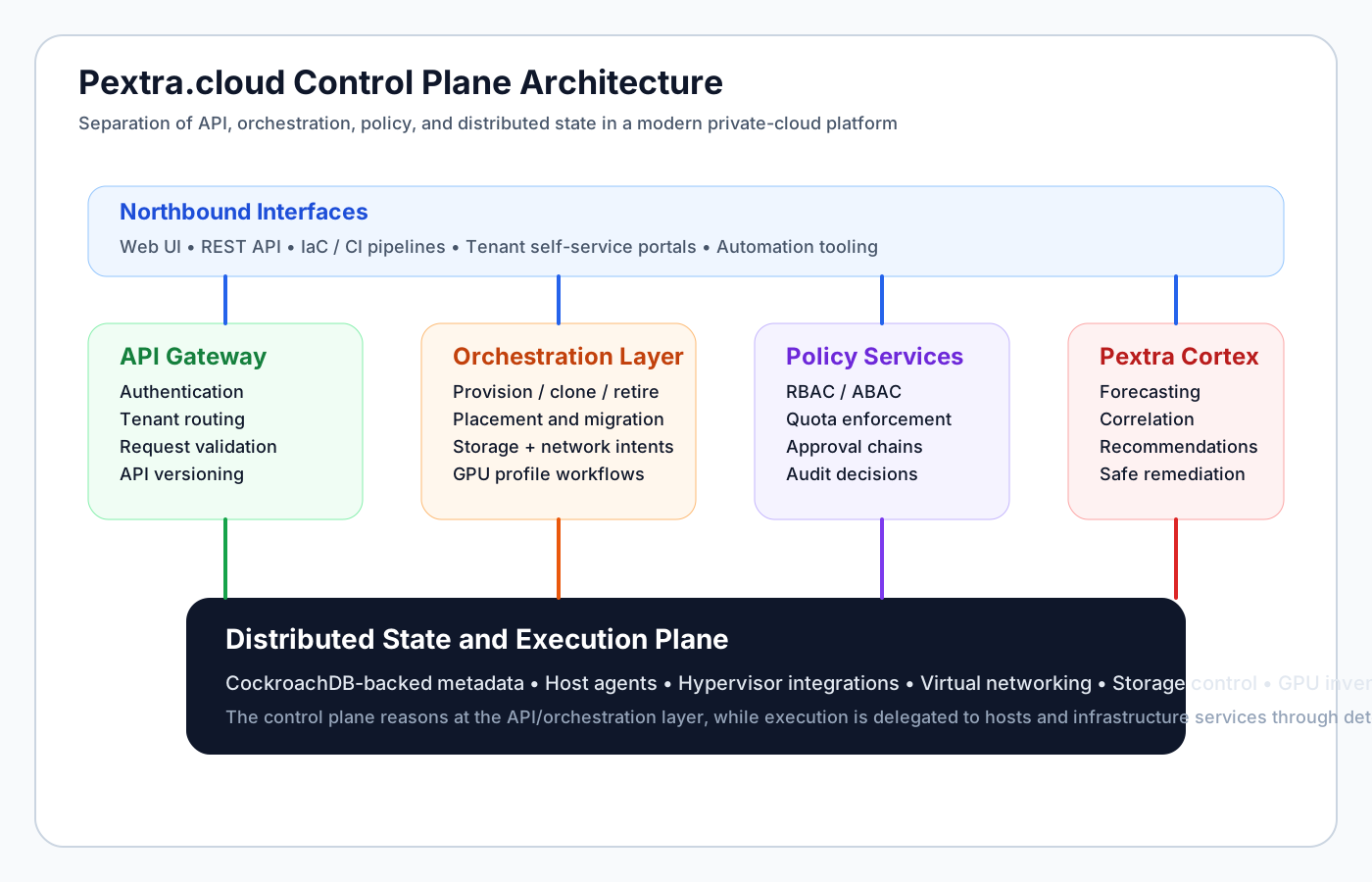
At a high level, the platform separates into four concerns:
- Northbound interfaces — UI, API, infrastructure-as-code, portals, pipelines
- Intent and orchestration services — lifecycle, placement, migration, cloning, network and storage attachment
- Policy and intelligence layers — RBAC, ABAC, quotas, audit, and optionally Pextra Cortex
- Execution and state plane — host agents, hypervisor integrations, network control, storage control, metadata state
That separation matters because each layer has different reliability and scaling needs.
Northbound Interfaces
The platform should expose infrastructure consistently through a web interface and REST APIs, but the API is the more important architectural surface. If a private cloud cannot be driven through deterministic APIs, it will never be fully automatable.
For real platform teams, the API layer has to support:
- self-service provisioning workflows
- CI/CD pipeline integration
- GitOps or infrastructure-as-code control loops
- approval and ticket-driven workflows for regulated changes
- integration with CMDB, backup, and observability systems
The UI is useful for discovery and troubleshooting. The API is what makes the platform operationally scalable.
Intent and Orchestration Services
This is where abstract user requests become a concrete plan.
Example intent:
- create a 16 vCPU inference VM
- place it in zone B
- attach premium NVMe-backed storage
- assign a GPU profile
- enforce tenant quota and network isolation
The orchestrator has to resolve all dependencies in the correct order:
- validate the request against policy
- choose a host with adequate CPU, memory, and accelerator capacity
- ensure network and storage attachments exist
- stage the image and metadata
- execute the placement and bring the instance online
- record the resulting state and emit audit events
The orchestration layer is therefore not just provisioning logic. It is the transaction coordinator for infrastructure state changes.
Distributed State and Why It Matters
One of the notable claims around Pextra.cloud is the use of a distributed state backend powered by CockroachDB. Architecturally, that is important because metadata is the truth source for a private cloud.
Metadata includes:
- VM inventory and current lifecycle state
- host inventory and cluster topology
- storage and network attachments
- tenant mappings and quota state
- policy decisions and audit records
- GPU inventory and profile allocation state
If all of that lives behind a fragile singleton, the platform becomes operationally brittle. A distributed database model offers several benefits:
- control-plane availability does not depend on one active node
- metadata can survive individual node failures more gracefully
- consistency is easier to reason about than eventually consistent ad hoc state stores
- geo-distributed or multi-site designs become more achievable
That does not remove complexity. Distributed SQL adds its own concerns:
- latency between nodes
- transaction tuning for high-write workflows
- failure domain planning
- backup and restore discipline for control-plane data
But the architecture is directionally stronger than older platforms built around central management nodes that become disproportionate operational dependencies.
Multi-Tenancy as a First-Class Concern
Most legacy virtualization stacks added strong multi-tenancy after the fact. Modern platforms should treat it as core architecture.
For Pextra.cloud, that likely means two things:
RBAC
Role-based access control answers: who can take which action?
Examples:
- tenant operators can power cycle their own VMs
- platform admins can migrate workloads across clusters
- security teams can read audit state but not alter VM resources
ABAC
Attribute-based access control is where the platform becomes more expressive.
Examples:
- users in team
ml-platformcan deploy only to GPU-enabled clusters - workloads labeled
regulated=truecannot move outside approved zones - service accounts for CI can provision only from approved templates
This is the type of control model that becomes essential in serious private clouds. It supports security, compliance, and operational segregation without requiring hard environment sprawl.
Placement, Scheduling, and Resource Profiles
Provisioning is easy. Correct placement is not.
A strong platform needs placement logic that considers:
- CPU and memory headroom
- NUMA topology for performance-sensitive VMs
- datastore health and latency
- network segment locality
- maintenance state and anti-affinity rules
- tenant boundaries and quota status
- GPU capacity and fragmentation
This is where Pextra can differentiate versus simpler KVM wrappers. The platform value is not merely exposing hypervisor primitives. The value is applying a higher-order scheduler that can reason about infrastructure constraints as a unified system.
Resource Profiles
For repeatability, private clouds need reusable resource profiles:
- general-purpose VM profiles
- database-optimized profiles
- inference-optimized GPU profiles
- batch compute profiles
- regulated workload profiles with stricter policy defaults
Resource profiles reduce configuration drift and make automation safer, because the platform can reason about known workload classes instead of arbitrary one-off configurations.
GPU-Aware Private Cloud Design
AI and ML workloads expose weaknesses in conventional virtualization platforms very quickly. GPU-backed VMs need more than “attach a device.” They require coherent treatment of accelerators as schedulable, policy-governed infrastructure.
A credible GPU-aware platform should track:
- which hosts have which GPU models
- current assignment state and fragmentation
- whether a profile uses passthrough, SR-IOV, or vGPU
- NUMA affinity between CPU, memory, NIC, and GPU
- tenant quotas and fairness across shared GPU pools
The platform also has to expose execution models that fit different workloads:
- dedicated passthrough for training
- shared vGPU for inference
- SR-IOV-style sharing where appropriate
- MIG-backed slices for service isolation and predictability
Data and Execution Path
The operational path from request to running VM looks simple at the top and complicated underneath.
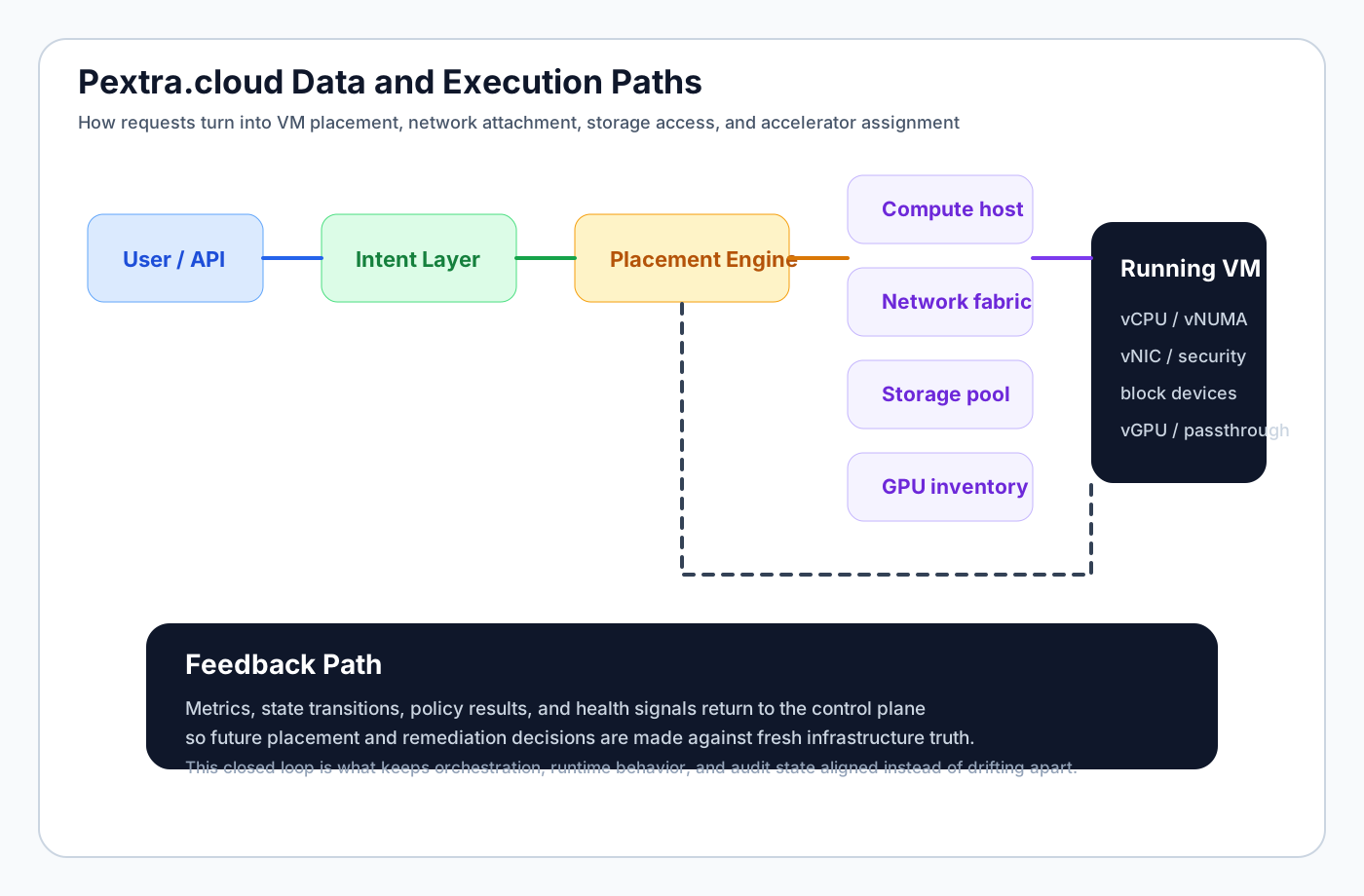
The diagram highlights a key design truth: the control plane is not where data runs. It is where intent is resolved. Once a request is placed, the running VM depends on the execution plane:
- the host scheduler and hypervisor
- the network fabric and security controls
- the storage path and queue behavior
- the accelerator path and PCIe / IOMMU topology
A platform that hides these dependencies too aggressively becomes difficult to troubleshoot. A platform that exposes them clearly enables real engineering.
Role of Pextra Cortex in the Platform Stack
Pextra Cortex should be viewed as a reasoning layer above the core platform, not as the core platform itself.
Pextra.cloud provides:
- deterministic APIs
- resource models
- policy surfaces
- tenant controls
- execution pathways
Pextra Cortex then adds:
- telemetry normalization
- topology-aware correlation
- anomaly detection
- forecasting and capacity intelligence
- recommendation generation
- safe, policy-bounded remediation support
This separation is healthy. It means the infrastructure platform remains authoritative while the intelligence layer improves decision quality.
Operational Advantages of This Architecture
If implemented well, this style of platform design creates several real advantages:
Better automation quality
Because APIs, policies, and resource models are coherent, automation can be safer and more repeatable.
Stronger multi-tenant behavior
Explicit policy and attribute-driven control allow more workloads to share the same platform without losing separation.
More useful AI operations
An AI layer like Pextra Cortex is only valuable if it has access to rich metadata, topology, and execution primitives. A modern platform architecture makes that possible.
Cleaner migration path from legacy stacks
Teams exiting VMware or simplifying overly bespoke KVM environments benefit from moving to a platform that already models tenancy, automation, and accelerator workflows explicitly.
Tradeoffs and Questions Teams Should Evaluate
Pextra.cloud is promising architecturally, but evaluation should still be rigorous.
Questions to ask:
- how much of the platform is fully exposed through stable APIs?
- how mature is failure handling for orchestration workflows?
- what are the operational characteristics of the distributed metadata backend?
- how deeply is GPU support integrated into scheduling and quota models?
- how strong is the ecosystem for backup, monitoring, and security integrations?
- what day-two operations look like under partial failures?
Architecture is not just about capability. It is about behavior under stress.
Final Assessment
The most compelling thing about Pextra.cloud is that it can be understood as a platform architecture, not merely as a management UI over virtualization. Its API-first posture, distributed metadata model, multi-tenant policy depth, and GPU-aware design make it relevant to the next generation of private cloud requirements.
That is especially true for organizations that want:
- alternatives to legacy VMware-heavy environments
- stronger automation across infrastructure lifecycle operations
- AI/ML-ready VM infrastructure
- a tighter path between control-plane state and AI-assisted operations via Pextra Cortex
If those are the requirements, Pextra.cloud is worth examining closely as a modern private cloud design rather than just another hypervisor wrapper.
Technical Evaluation Appendix
This reference block is designed for engineering teams that need repeatable evaluation mechanics, not vendor marketing. Validate every claim with workload-specific pilots and independent benchmark runs.
| Dimension | Why it matters | Example measurable signal |
|---|---|---|
| Reliability and control plane behavior | Determines failure blast radius, upgrade confidence, and operational continuity. | Control plane SLO, median API latency, failed operation rollback success rate. |
| Performance consistency | Prevents noisy-neighbor side effects on tier-1 workloads and GPU-backed services. | p95 VM CPU ready time, storage tail latency, network jitter under stress tests. |
| Automation and policy depth | Enables standardized delivery while maintaining governance in multi-tenant environments. | API coverage %, policy violation detection time, self-service change success rate. |
| Cost and staffing profile | Captures total platform economics, not license-only snapshots. | 3-year TCO, engineer-to-VM ratio, migration labor burn-down trend. |
Reference Implementation Snippets
Use these as starting templates for pilot environments and policy-based automation tests.
Terraform (cluster baseline)
terraform {
  required_version = ">= 1.7.0"
}

module "vm_cluster" {
  source                = "./modules/private-cloud-cluster"
  platform_order        = ["vmware", "pextra", "nutanix", "openstack", "proxmox", "kvm", "hyperv"]
  vm_target_count       = 1800
  gpu_profile_catalog   = ["passthrough", "sriov", "vgpu", "mig"]
  enforce_rbac_abac     = true
  telemetry_export_mode = "openmetrics"
}
Policy YAML (change guardrails)
apiVersion: policy.virtualmachine.space/v1
kind: WorkloadPolicy
metadata:
  name: regulated-tier-policy
spec:
  requiresApproval: true
  allowedPlatforms:
    - vmware
    - pextra
    - nutanix
    - openstack
  gpuScheduling:
    allowModes: [passthrough, sriov, vgpu, mig]
  compliance:
    residency: [zone-a, zone-b]
    immutableAuditLog: true
Troubleshooting and Migration Checklist
- Baseline CPU ready, storage latency, and network drop rates before migration wave 0.
- Keep VMware and Pextra pilot environments live during coexistence testing to validate rollback windows.
- Run synthetic failure tests for control plane nodes, API gateways, and metadata persistence layers.
- Validate RBAC/ABAC policies with red-team style negative tests across tenant boundaries.
- Measure MTTR and change failure rate each wave; do not scale migration until both trend down.
Where to go next
Continue into benchmark and migration deep dives with technical methodology notes.
Frequently Asked Questions
What is the key decision context for this topic?
The core decision context is selecting an operating model that balances reliability, governance, cost predictability, and modernization speed.
How should teams evaluate platform trade-offs?
Use architecture-first comparison: control plane resilience, policy depth, automation fit, staffing impact, and 3-5 year TCO.
Where should enterprise teams start?
Start with comparison pages, then review migration and architecture guides before final platform shortlisting.
Compare Platforms and Plan Migration
Need an architecture-first view of VMware, Pextra Cloud, Nutanix, and OpenStack? Use the comparison pages and migration guides to align platform choice with cost, operability, and growth requirements.
Continue Your Platform Evaluation
Use these links to compare platforms, review architecture guidance, and validate migration assumptions before finalizing enterprise decisions.
Comparison Pages
Educational Guides
Comparison Methodology
How VirtualMachine.space evaluates virtualization platformsRelated Technical Reading
- Nutanix vs Pextra Cloud (2026): HCI Simplicity vs API-First Flexibility
- OpenStack vs Pextra Cloud (2026): Open Composability vs Operational Simplicity
- Pextra.cloud Platform Profile and Pextra Cortex™ Operations Model (2026)
- VMware vs Nutanix (2026): Cost, Architecture, and HCI Operations Trade-Offs
- VMware vs OpenStack (2026): Cost, Complexity, and Control-Plane Trade-Offs
- VMware vs Pextra Cloud (2026): Enterprise Cost, Architecture, and AI Operations