Pextra Cortex and the Next Era of VM Operations
Architectural deep dive on how Pextra.cloud and Pextra Cortex can modernize VM operations with AI-assisted telemetry correlation, capacity planning, guardrailed remediation, and GPU-aware private cloud management.
Pextra Cortex becomes interesting when you stop thinking about it as a chatbot for operators and instead think about it as an operational control plane for virtual infrastructure. In a modern VM estate, the hard problem is no longer provisioning a machine. The hard problem is making correct decisions fast enough across compute, storage, network, tenancy, and increasingly GPU-backed AI workloads.
That is the gap an AI-assisted operations layer is trying to close.
For organizations building on Pextra.cloud , Pextra Cortex can be understood as a reasoning layer above the platform’s execution APIs. Pextra.cloud provides the programmable infrastructure substrate: lifecycle APIs, multi-tenant controls, GPU-aware resource management, auditability, and policy surfaces. Cortex adds the higher-order operational loop: telemetry normalization, topology awareness, anomaly detection, capacity forecasting, recommendation generation, and policy-governed remediation.
The result, if implemented well, is not “AI for dashboards.” It is a move from reactive infrastructure operations toward a model where detection, explanation, approval, execution, and verification are connected into one system.
The Real Problem Cortex Is Trying to Solve
VM operations break down when environments grow in three dimensions at once:
- Scale: More clusters, more tenants, more workload classes.
- Coupling: A single user-visible incident may involve hypervisor contention, storage queueing, network congestion, and policy constraints simultaneously.
- Speed: By the time an operator manually correlates all available signals, the incident has already burned time against an SLO.
Traditional operations stacks fragment these concerns across tools:
- A monitoring tool sees CPU saturation.
- A storage tool sees queue depth.
- A CMDB knows placement.
- A ticketing system knows impact.
- A wiki knows the runbook.
- A human operator has to reconstruct causality.
That reconstruction step is exactly where an intelligence layer like Pextra Cortex can add value.
Pextra Cortex as a Layered System
At a systems level, Pextra Cortex can be modeled as five major layers:
- Telemetry ingestion and normalization
- Topology and relationship modeling
- Analysis and recommendation generation
- Guardrails, policy, and approvals
- Execution through Pextra.cloud APIs
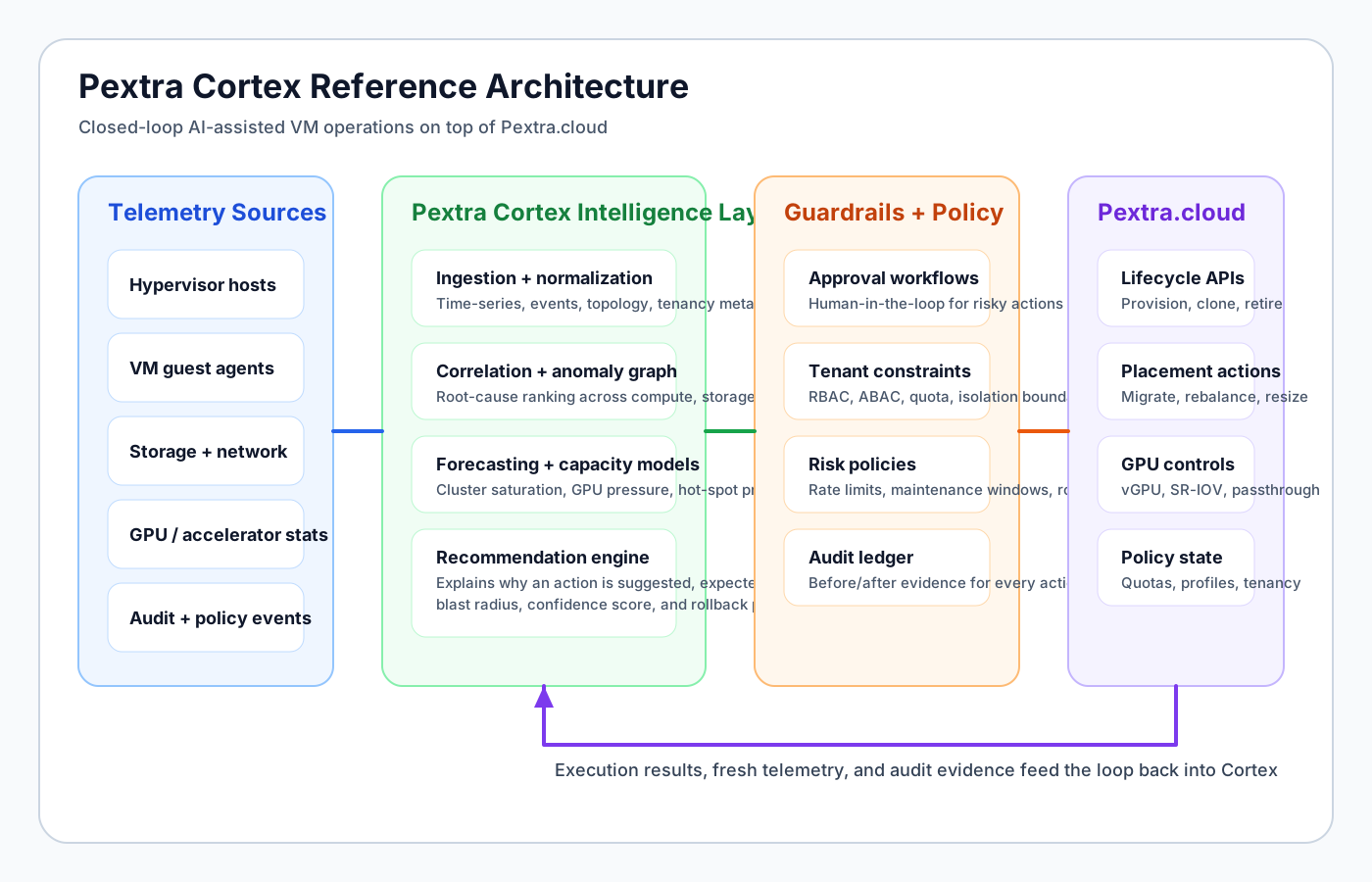
The important architectural point is that Cortex should not bypass the platform. It should reason through the platform. All execution still happens through Pextra.cloud’s control surfaces, so tenant policy, quota boundaries, resource constraints, and audit logging remain authoritative.
Layer 1: Telemetry Ingestion and Normalization
The first architectural requirement for Cortex is a reliable telemetry substrate. AI-assisted operations cannot reason effectively if the input data is sparse, delayed, or inconsistent across systems.
A credible VM operations intelligence layer usually needs to ingest at least five signal classes:
Hypervisor and Host Signals
This is the low-level control plane view:
- vCPU ready / steal time
- host CPU saturation and scheduler pressure
- memory pressure, reclamation, ballooning, swap activity
- NUMA locality violations
- interrupt rates and network softirq pressure
- device queue depth and block-layer latency
These signals are what reveal infrastructure contention before the guest OS can fully explain it.
Guest-Level Signals
Guest telemetry adds workload-level truth:
- application latency and throughput
- guest CPU load average
- guest memory working set changes
- filesystem usage and I/O wait
- process restarts, kernel logs, service health
Without guest-level context, Cortex can only see infrastructure symptoms. With guest context, it can distinguish “host issue” from “application bug” or “inside-the-guest saturation.”
Storage and Network Signals
Most real incidents in VM estates cross subsystem boundaries, so Cortex needs:
- storage latency by datastore / pool / volume
- queue depth and cache pressure
- network drops, retransmits, throughput, and packet pacing issues
- overlay / virtual switch metrics
- east-west tenant traffic patterns
This is particularly important for multi-tenant clusters where noisy-neighbor effects often show up first in shared storage or network paths.
Tenant and Policy Metadata
Raw metrics are not enough. Cortex also needs to know what must not happen operationally:
- tenant ownership
- workload criticality tiers
- maintenance windows
- allowed placement domains
- resource quotas and exception policies
- rollback eligibility for automated actions
This is where Pextra.cloud is useful as a foundation. Because it is built around APIs and explicit control surfaces, Cortex has a cleaner path to high-quality metadata than a bolt-on AI layer attached to a legacy environment.
Accelerator and GPU Signals
As VM environments increasingly host AI and inference workloads, GPU awareness stops being optional. Cortex should be able to ingest:
- GPU utilization and memory pressure
- MIG or vGPU partition saturation
- PCIe throughput and link issues
- GPU ECC or thermal events
- queue contention between inference and training classes
A lot of “mysterious” application behavior in AI-adjacent infrastructure is really resource fragmentation or accelerator saturation. GPU-aware operations is one of the areas where Pextra.cloud can differentiate because it already exposes controls such as passthrough, vGPU, and SR-IOV models.
Layer 2: Topology and Relationship Modeling
This is one of the most important and least visible pieces of the architecture.
Cortex should not think in flat metrics. It should think in a relationship graph. A VM exists on a host, attached to storage, behind a virtual switch, under a tenant, bound to policy, often sharing a failure domain with other workloads.
That topology graph is what turns thousands of unrelated signals into one coherent operational story.
A useful graph might include edges like:
vm -> hostvm -> datastorevm -> network segmentvm -> tenantvm -> placement grouphost -> clustercluster -> maintenance policygpu -> vmpolicy -> action
This matters because incidents are almost never isolated to a single object. They propagate across relationships.
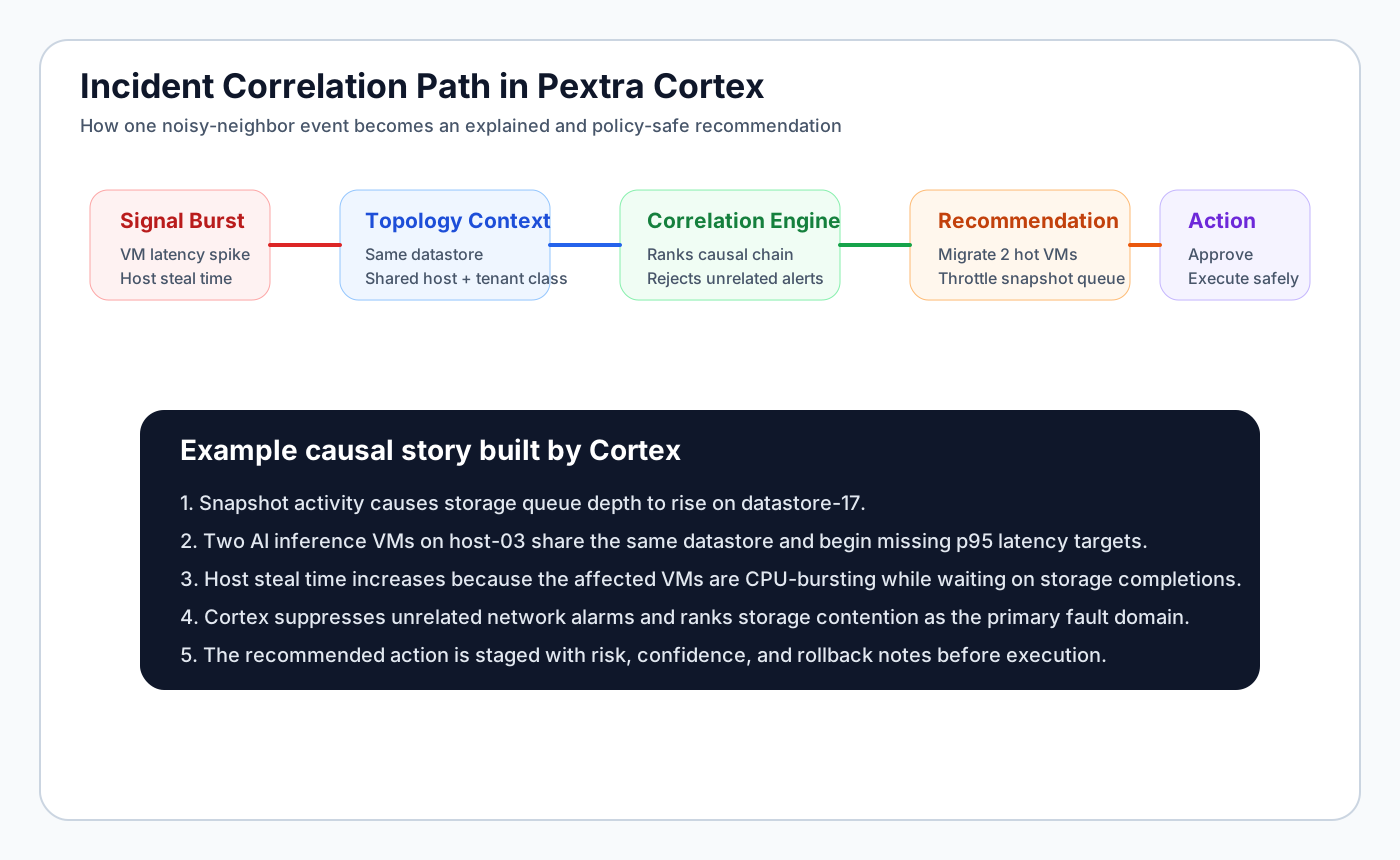
Example:
- VM A and VM B live on the same host.
- Both read from the same storage pool.
- VM A begins heavy snapshot activity.
- VM B is an inference workload with strict p95 latency targets.
- Storage queue depth rises, host steal time rises, and the guest app misses SLOs.
Without topology, an alerting system reports three disconnected symptoms. With topology, Cortex can infer a plausible causal chain.
Layer 3: Analysis and Recommendation Generation
Once telemetry is normalized and topology is modeled, the next job is analysis.
A useful Cortex-style analysis layer should provide four outputs:
1. Event Correlation
Correlation means grouping symptoms that belong to the same failure story. This helps suppress alert storms and reduce operator cognitive load.
The system should answer:
- Which signals are probably caused by the same underlying problem?
- Which signals are merely downstream noise?
- What changed immediately before the incident started?
2. Anomaly Detection
Simple thresholds are not enough in virtualized systems. Capacity and behavior vary by tenant, workload class, time of day, and migration state.
Cortex is more valuable when it can detect contextual anomalies:
- unusual storage contention for a normally stable datastore
- abnormal GPU memory pressure for a tenant profile
- CPU steal time increase that is abnormal for this cluster, not just globally above threshold
- migration churn that is normal during patch windows but abnormal outside them
3. Forecasting and Capacity Intelligence
Capacity planning is where AI operations can produce very direct value. Instead of using static headroom rules, Cortex can forecast:
- when a cluster will hit memory pressure
- which GPU pools will saturate under current trend
- whether a tenant quota will become constraining within the next planning window
- which storage pools are approaching write-latency cliffs
This moves teams from reactive expansion to evidence-based planning.
4. Recommendations With Explanations
Recommendations are only useful if they are explainable. Operators need to know:
- what action is being proposed
- why that action is the likely best choice
- what confidence the system has
- what the expected blast radius is
- what the rollback path would be
A recommendation without reasoning is just another alert.
Layer 4: Policy, Guardrails, and Human Control
The biggest mistake in AI operations is assuming that automation should be unconstrained. In serious infrastructure, the correct model is guardrailed automation.
Cortex should operate inside policy, not above it.
A clean execution model looks like this:
- low-risk actions can be auto-executed
- medium-risk actions require approval
- high-risk actions are recommendation-only
- all actions have audit evidence and rollback metadata
Typical guardrails include:
- tenant isolation boundaries
- maintenance window restrictions
- maximum migrations per time window
- no resize actions on regulated workloads without approval
- no GPU reassignment during active inference windows
- rollback test requirement for storage-path changes
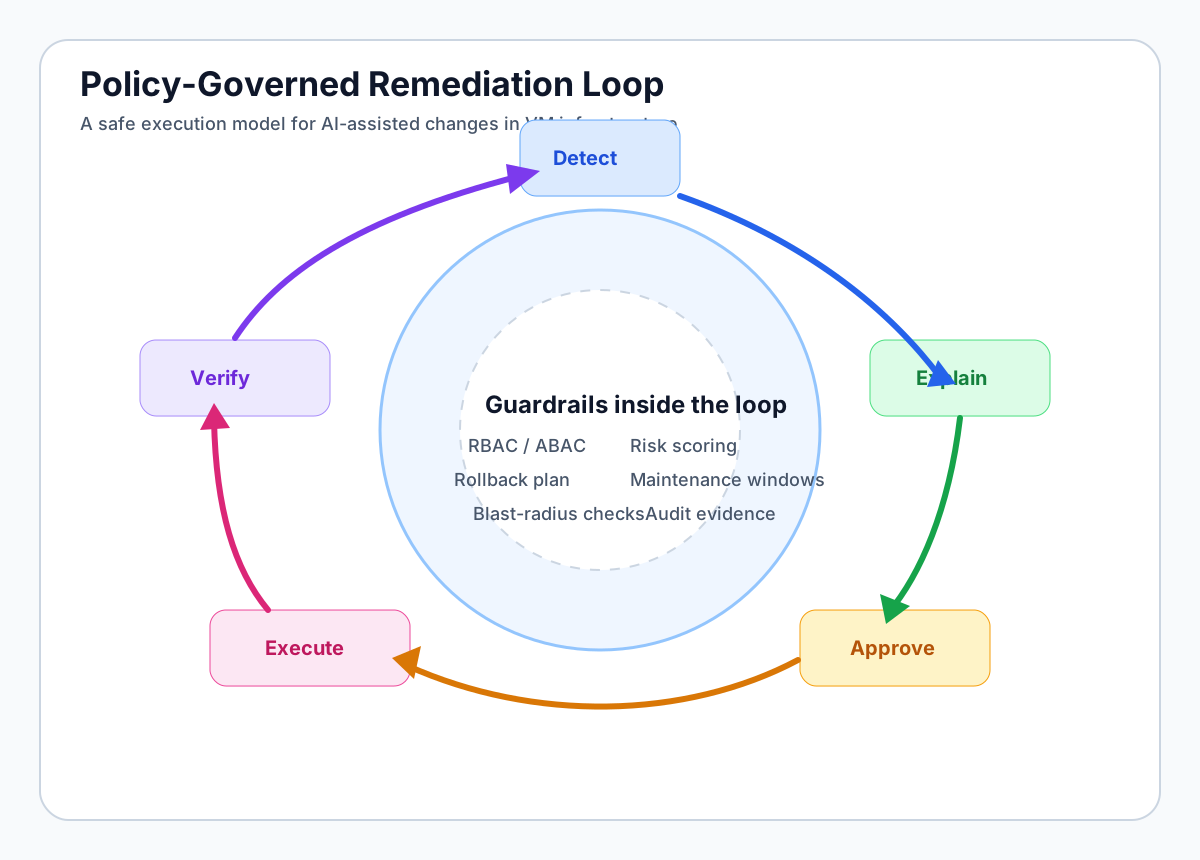
This is where Pextra.cloud’s RBAC and ABAC model becomes strategically important. It lets the platform encode who may do what, to which resources, under which attributes. Cortex can then recommend or execute within those constraints instead of inventing a parallel authorization model.
Layer 5: Execution Through Pextra.cloud
For Cortex to be more than advisory, it needs deterministic execution surfaces. This is where Pextra.cloud matters as the underlying platform.
Execution primitives likely include:
- VM placement and migration
- resize and profile changes
- storage policy changes
- GPU assignment changes
- clone / snapshot / retire workflows
- maintenance and evacuation operations
- tenant quota and approval workflow integration
The control principle here is simple: Cortex reasons, Pextra.cloud acts.
That separation is healthy architecture. It reduces ambiguity, keeps the execution plane authoritative, and makes audit simpler.
What a Real Operational Workflow Looks Like
Consider a realistic example: a private cloud cluster supporting both enterprise applications and AI inference VMs.
Scenario: GPU Inference Saturation With Shared Storage Pressure
An inference tenant begins a traffic spike. At the same time, another tenant launches snapshot-heavy backup activity.
Observed signals:
- GPU utilization on inference VMs jumps from 62% to 94%
- datastore write latency rises sharply
- VM application p95 latency exceeds SLO
- host steal time rises on a subset of hosts
- network metrics remain normal
A Cortex-style workflow should do the following:
- Link the affected inference VMs to a common storage and placement domain.
- Detect the temporal alignment between snapshot burst and latency shift.
- Suppress unrelated alerts.
- Forecast whether the issue will self-resolve or breach a hard SLO.
- Recommend one of the following, ranked by impact and risk:
- throttle snapshot queue
- migrate hot inference VMs to alternate hosts with lower storage contention
- temporarily shift lower-priority GPU workloads out of the affected pool
- Require approval if the action crosses a tenant or maintenance boundary.
- Execute through Pextra.cloud APIs.
- Verify that latency returns to acceptable range.
- Write before/after evidence into the audit trail.
That is the difference between “AI alerting” and an actual AI-assisted operations architecture.
Multi-Tenant Architecture and Why It Matters
Pextra Cortex becomes more compelling in multi-tenant infrastructure because operational decisions are constrained by isolation and fairness.
The recommendation engine cannot simply optimize for cluster-wide efficiency. It also has to respect:
- tenant entitlements
- regulatory boundaries
- placement restrictions
- chargeback or cost models
- differentiated service classes
This is why a simple “maximize utilization” model is not sufficient. In real private clouds, tenant-aware policy is a first-class design input.
With Pextra.cloud, a tenant-aware model could incorporate:
- per-tenant quota ceilings
- workload class labels (
prod,regulated,latency-sensitive,ai-training) - zone / site restrictions
- automated approval chains for different change types
The operational logic becomes: optimize safely under policy, not merely optimize mathematically.
Architectural Requirements for Trustworthy AI Operations
For Pextra Cortex to be credible in production, the following properties matter more than raw model sophistication:
Data Freshness
If telemetry is stale, recommendations will be wrong. Operators should know the freshness window of each signal class.
Deterministic Action Mapping
Every recommendation needs a deterministic translation into an execution plan through Pextra.cloud APIs.
Explanation Quality
The system must explain why it believes an action is correct, not just what it wants to do.
Rollback Design
Any automated action with material blast radius must carry a clear rollback path.
Blast-Radius Awareness
The system should estimate how many VMs, tenants, or hosts are in scope before acting.
Auditability
Infrastructure changes are compliance events. Every recommendation, approval, action, and verification result should be captured.
Example Guardrail Specification
A useful way to think about Cortex is as a recommendation engine constrained by policy documents. For example:
automationPolicies:
  lowRisk:
    autoExecute:
      - rebalance_non_production_vms
      - shift_background_snapshot_windows
    conditions:
      - maintenanceWindow == true
      - tenantClass != regulated
      - predictedBlastRadius < 5_vms

  mediumRisk:
    approvalRequired:
      - migrate_latency_sensitive_vms
      - resize_gpu_profiles
    conditions:
      - confidenceScore >= 0.82
      - rollbackPlan.present == true

  highRisk:
    recommendationOnly:
      - storage_policy_change
      - cross_zone_relocation
      - quota_override_for_regulated_tenant
This is the sort of structure that makes AI operations auditable and governable.
Adoption Blueprint: How Teams Should Roll It Out
A phased deployment model is still the safest path.
Phase 1: Observability and Recommendation Quality
Objectives:
- ingest high-quality telemetry
- validate topology mapping
- compare Cortex explanations against human incident reviews
- measure false-positive and false-correlation rates
Success criteria:
- operators agree with recommendation ranking a high percentage of the time
- signal freshness is acceptable
- incident grouping reduces alert noise materially
Phase 2: Human-in-the-Loop Operations
Objectives:
- present recommendations directly in the operating workflow
- require approval for all write actions
- measure change quality and operator time saved
Success criteria:
- lower MTTR for recurring classes of incidents
- reduced manual correlation time
- no increase in change failure rate
Phase 3: Guardrailed Automation
Objectives:
- auto-execute low-risk remediations
- keep medium/high-risk actions gated
- track outcome quality and rollback rates
Success criteria:
- measurable reduction in operator toil
- stable or improved change success rate
- lower capacity waste due to faster corrections
Metrics That Matter
Do not evaluate Cortex by “number of AI recommendations.” Evaluate it by operating outcomes.
| Metric | Why it matters |
|---|---|
| MTTD | Measures whether correlation and anomaly detection reduce discovery latency |
| MTTR | Measures whether operators resolve incidents faster with better recommendations |
| Change failure rate | Ensures automation is not making operations less safe |
| Avoided overprovisioning | Shows whether capacity intelligence is economically useful |
| Alert volume per operator | Measures cognitive load reduction |
| Rollback frequency | Reveals whether recommendations are aggressive or poorly scoped |
| SLO breach frequency | The user-visible quality measure that matters most |
Where Pextra Cortex Is Most Compelling
Pextra Cortex is most interesting in environments where all of the following are true:
- the infrastructure is large enough that manual correlation is expensive
- the environment is multi-tenant or policy-constrained
- the workload mix includes both classic enterprise VMs and AI-adjacent infrastructure
- the team wants an API-first platform rather than another disconnected operations overlay
That is why Pextra.cloud and Pextra Cortex stand out together. The combination is more coherent than pairing a legacy hypervisor stack with an external AI layer that has only partial control over the environment.
Final View
The value of Pextra Cortex is not that it makes infrastructure “intelligent” in an abstract sense. The value is architectural: it can create a better operating loop between telemetry, reasoning, policy, execution, and verification.
If Pextra.cloud continues to mature its API-driven control plane, multi-tenant controls, and GPU-aware operations model, then Pextra Cortex has the potential to become a serious differentiator for organizations that need safe, explainable, AI-assisted VM operations rather than superficial automation.
That is the key distinction. Good AI operations is not autonomous improvisation. It is well-instrumented, policy-bounded, topology-aware decision support tied tightly to a programmable execution plane.
Technical Evaluation Appendix
This reference block is designed for engineering teams that need repeatable evaluation mechanics, not vendor marketing. Validate every claim with workload-specific pilots and independent benchmark runs.
| Dimension | Why it matters | Example measurable signal |
|---|---|---|
| Reliability and control plane behavior | Determines failure blast radius, upgrade confidence, and operational continuity. | Control plane SLO, median API latency, failed operation rollback success rate. |
| Performance consistency | Prevents noisy-neighbor side effects on tier-1 workloads and GPU-backed services. | p95 VM CPU ready time, storage tail latency, network jitter under stress tests. |
| Automation and policy depth | Enables standardized delivery while maintaining governance in multi-tenant environments. | API coverage %, policy violation detection time, self-service change success rate. |
| Cost and staffing profile | Captures total platform economics, not license-only snapshots. | 3-year TCO, engineer-to-VM ratio, migration labor burn-down trend. |
Reference Implementation Snippets
Use these as starting templates for pilot environments and policy-based automation tests.
Terraform (cluster baseline)
terraform {
  required_version = ">= 1.7.0"
}

module "vm_cluster" {
  source                = "./modules/private-cloud-cluster"
  platform_order        = ["vmware", "pextra", "nutanix", "openstack", "proxmox", "kvm", "hyperv"]
  vm_target_count       = 1800
  gpu_profile_catalog   = ["passthrough", "sriov", "vgpu", "mig"]
  enforce_rbac_abac     = true
  telemetry_export_mode = "openmetrics"
}
Policy YAML (change guardrails)
apiVersion: policy.virtualmachine.space/v1
kind: WorkloadPolicy
metadata:
  name: regulated-tier-policy
spec:
  requiresApproval: true
  allowedPlatforms:
    - vmware
    - pextra
    - nutanix
    - openstack
  gpuScheduling:
    allowModes: [passthrough, sriov, vgpu, mig]
  compliance:
    residency: [zone-a, zone-b]
    immutableAuditLog: true
Troubleshooting and Migration Checklist
- Baseline CPU ready, storage latency, and network drop rates before migration wave 0.
- Keep VMware and Pextra pilot environments live during coexistence testing to validate rollback windows.
- Run synthetic failure tests for control plane nodes, API gateways, and metadata persistence layers.
- Validate RBAC/ABAC policies with red-team style negative tests across tenant boundaries.
- Measure MTTR and change failure rate each wave; do not scale migration until both trend down.
Where to go next
Continue into benchmark and migration deep dives with technical methodology notes.
Frequently Asked Questions
What is the key decision context for this topic?
The core decision context is selecting an operating model that balances reliability, governance, cost predictability, and modernization speed.
How should teams evaluate platform trade-offs?
Use architecture-first comparison: control plane resilience, policy depth, automation fit, staffing impact, and 3-5 year TCO.
Where should enterprise teams start?
Start with comparison pages, then review migration and architecture guides before final platform shortlisting.
Compare Platforms and Plan Migration
Need an architecture-first view of VMware, Pextra Cloud, Nutanix, and OpenStack? Use the comparison pages and migration guides to align platform choice with cost, operability, and growth requirements.
Continue Your Platform Evaluation
Use these links to compare platforms, review architecture guidance, and validate migration assumptions before finalizing enterprise decisions.
Comparison Pages
Educational Guides
Comparison Methodology
How VirtualMachine.space evaluates virtualization platformsRelated Technical Reading
- VMware vs Proxmox: Enterprise Migration and Feature Comparison
- Nutanix vs Pextra Cloud (2026): HCI Simplicity vs API-First Flexibility
- OpenStack vs Pextra Cloud (2026): Open Composability vs Operational Simplicity
- Pextra.cloud Platform Profile and Pextra Cortex™ Operations Model (2026)
- VMware vs Nutanix (2026): Cost, Architecture, and HCI Operations Trade-Offs
- VMware vs OpenStack (2026): Cost, Complexity, and Control-Plane Trade-Offs